
JOURNAL 2488
Records of Agricultural and Food Chemistry
Year: 2026 Issue: 1
p.3 - 3
Viewed 138 times.
-
Blaise Kom

-
Gertrude Eleonore Djiobie Tchienou
-
Abdourahman Fadimatou
-
Wan Mohd Nuzul Hakimi Wan Salleh
-
Abubakar Siddiq Salihu
-
Tamfu Alfred Ngenge
GRAPHICAL ABSTRACT
ABSTRACT
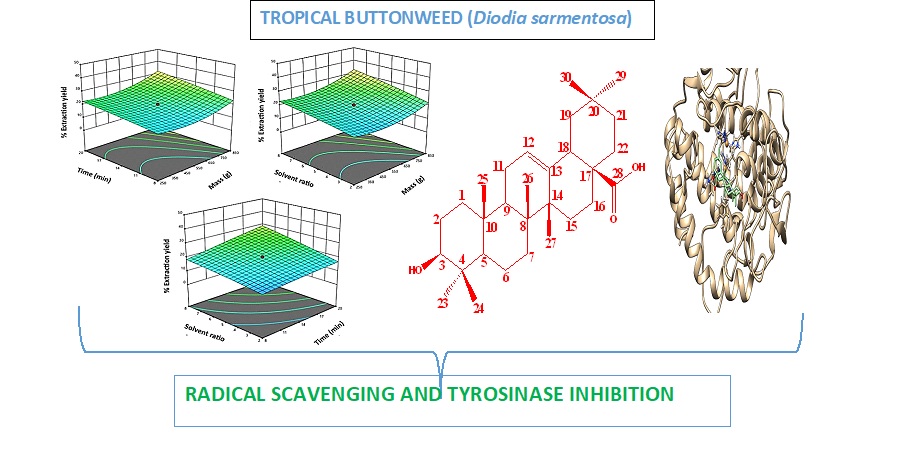
Diodia sarmentosa, also known as tropical buttonweed, is used traditionally as a culinary ingredient and medicinal plant. This work focused on the determination of optimum conditions for extraction with high yields and evaluation of antityrosinase and antiradical properties of D. sarmentosa. Optimization of extraction was performed using response surface methodology (RSM) based on a central composite design. Three variables including mass of plant material, extraction time and ethanol proportion were used for the extraction under ultrasound-assisted conditions and the major compound was isolated and characterized using 1H NMR and 13C NMR as oleanolic acid (OA). The yield of extraction was significantly influenced by mass of plant material, ethanol ratio and extraction time. Highest extraction yield of 40.42% was obtained from 850 g of plant material for an extraction time of 20 mins with ethanol proportion of 80% in water. The extracts resulting from experiments with best yields 40.42 % and 37.02% were exhibited good antiradical property with IC50 values of 08.1±0.5 µg/mL and 08.7±0.4 µg/mL in the DPPH· assay. The extract with a yield of 28.47%, obtained from 850 g of plant material, after 8 mins of extraction time in 80% ethanol proportion had highest tyrosinase inhibition with IC50 value of 52.7±1.4 µg/mL. These suggest that mass of plant material and ethanol proportion are important for tyrosinase inhibition and antiradical activities. Oleanolic acid showed very weak antiradical activity with moderate tyrosinase inhibition. Molecular docking showed low binding affinity with the binding sites of tyrosinase, mostly through Van der Waals interactions with a binding energy of -6.3 kcal/mol. However, the overall results indicate potential cosmetic and food applications of D. sarmentosa.
KEYWORDS- Diodia sarmentosa
- optimization of extraction
- radical scavenging
- tyrosinase inhibition
- oleanolic acid
